


Quantum Gravimetry meets a calving glacier in the Arctic
by Adam Ciesielski, Institute of Geodesy and Cartography, Poland
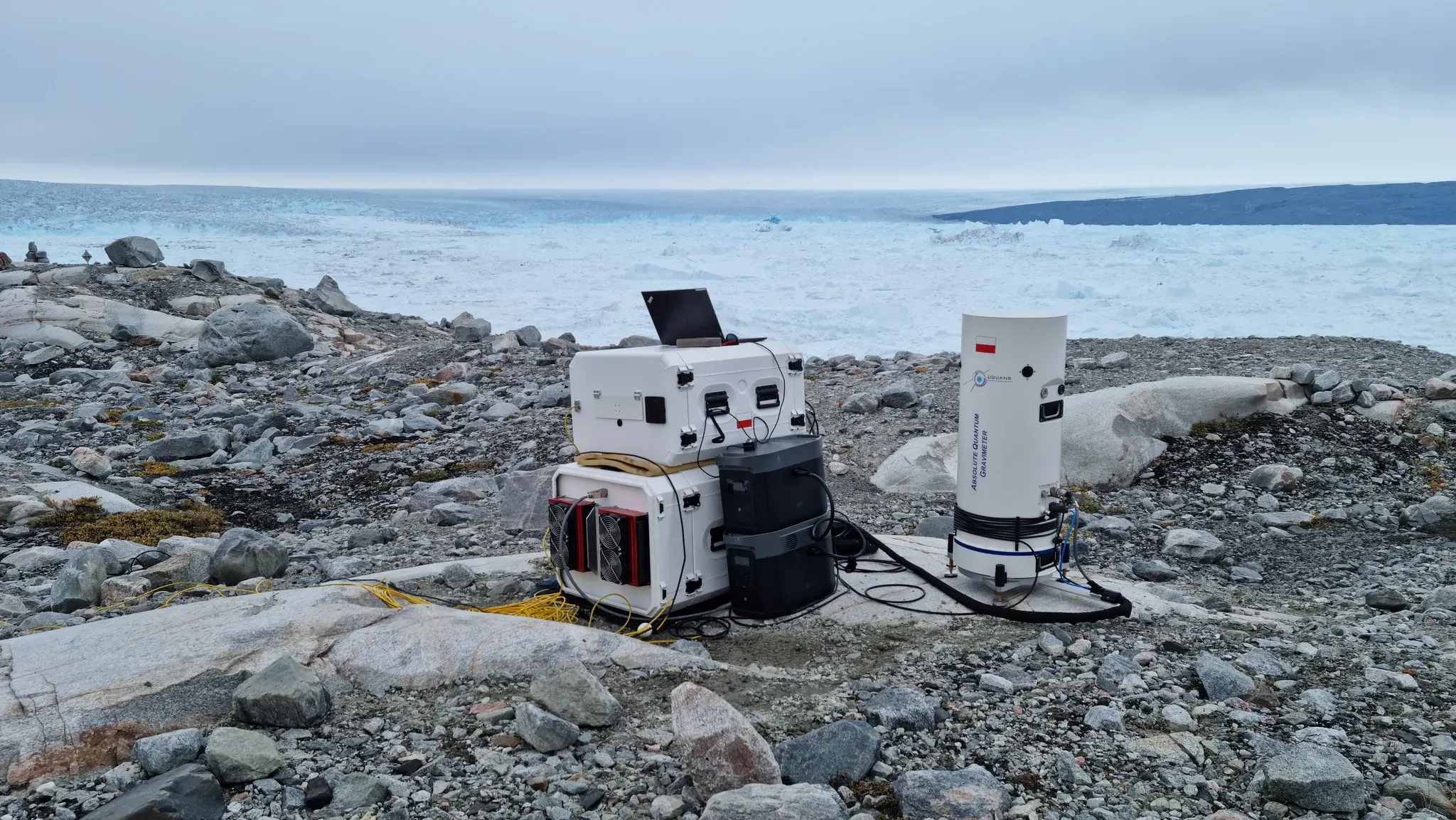
Gravimetry is the only method capable of directly sensing subsurface mass changes, making it critically important for resource management and risk assessment. The Absolute Quantum Gravimeter (AQG, in the photo) is a high-precision sensor that measures the Earth's gravitational acceleration by monitoring the free fall of laser-cooled atoms in a vacuum, rather than relying on mechanical masses. It has been developed as a portable device.
The Arctic, especially the calving front of Ilulissat glacier (light-blue region in the back of the photo), one of the fastest-flowing and most dynamically active glaciers in Greenland, is particularly interesting place for study mass changes. This particular glacier drains nearly 7% of the Greenland ice sheet, melting about 1 lake Constance per week, and it moves about 40 meters per day. The resulting interactions between ice, water, and solid Earth cause mass redistribution which is the subject of interest. The feasibility of robust investigation for long-period trends (years) and measurement repeatability is of special interest in climate science.
An absolute gravity measurement field campaign was conducted in summer 2025 at the Kangia North (KAGA) permanent GNSS station, located near the calving front of the Ilulissat Glacier. The instrument was deployed on a bedrock close to the glacier front, accessed only by helicopter approximately 50 km inland from Ilulissat (airport, town). The total operational time at the site was about 8 hours. The location was entirely remote, without access to power infrastructure and exposed to highly variable weather conditions.
It was the first time ever when instrument of this type (AQG) operated in such difficult conditions, including the associated logistical challenges of transport and operation. The primary objective was to evaluate the sensitivity and performance of absolute gravity measurements in this environment, while also assessing the feasibility of operating a quantum gravimeter under remote and harsh conditions.
Despite the challenges faced, the campaign was a milestone of the project which provided valuable insights. The lesson has been learnt and it can be considered a successful demonstration of the applicability in extreme settings.
The campaign was carried out within the project EQUIP-G (funded by the European Commission under the Horizon Europe program, grant number 101215427) and with support from the Danish Climate Data Agency, serving as a pilot study for future repeated quantum gravimetry observations in Greenland planned for 2028.
Categories
- Climate: Past, Present & Future (775)
- Cryospheric Sciences (753)
- Field (2946)
- Geodesy (58)
- Geodynamics (384)
- Hydrological Sciences (710)
- Interdisciplinary/Other (864)
Location
- North America (801)
- Northern America (630)
- Greenland (76)
- Exact location (-49.8161 W, 69.2220 N)
Tags
- glacier (196)
- greenland (56)
- bedrock (3)
- calving (4)
- field campaign (7)
- field measurements (4)
- gravimetry (2)
- quantum (2)
- ilulissat (1)
- icefjord (1)
Colours
Image properties
9248 × 5204 px;
image/jpeg; 14.4 MB
Camera:
Samsung SM-G991B
Taken on 14
August
2025
Submitted on 8 April 2026
Licence
Creative Commons Attribution 3.0 Unported (CC BY 3.0)
Credit
Adam Ciesielski (distributed via imaggeo.egu.eu)
Share
Appreciate
Report