


Improvised stability: Absolute Quantum Gravimetry in the Arctic
by Adam Ciesielski, Institute of Geodesy and Cartography, Poland
Across the high latitudes of the Arctic, where ice, ocean, and solid Earth remain in constant interaction, the redistribution of mass shapes both the landscape and the signals we use to understand it. Among the available geophysical methods, gravimetry is the only technique capable of directly sensing changes in subsurface mass. This makes it critically important for broad applications.
The discussed device is the Absolute Quantum Gravimeter (AQG), a high-precision sensor that measures the Earth's gravitational acceleration by monitoring the free fall of laser-cooled atoms in a vacuum, rather than relying on mechanical masses. Its potential of combining absolute accuracy with field applicability is under investigation.
Therefore a field campaign was conducted during summer 2025 in western Greenland. It focused on evaluating the sensitivity of absolute gravity measurements to mass redistribution processes associated with glacier dynamics, while also testing the feasibility of operating such an advanced instrument under remote and harsh field conditions.
For this reason absolute gravity measurements at the Kangia North (KAGA) permanent GNSS station, located near the calving front of the Ilulissat Glacier - one of the fastest-flowing and most dynamically active glaciers in Greenland - were conducted. The instrument was deployed on bedrock near the glacier front, reached by helicopter approximately 50 km inland from Ilulissat. The operational time at the site was about 8 hours.
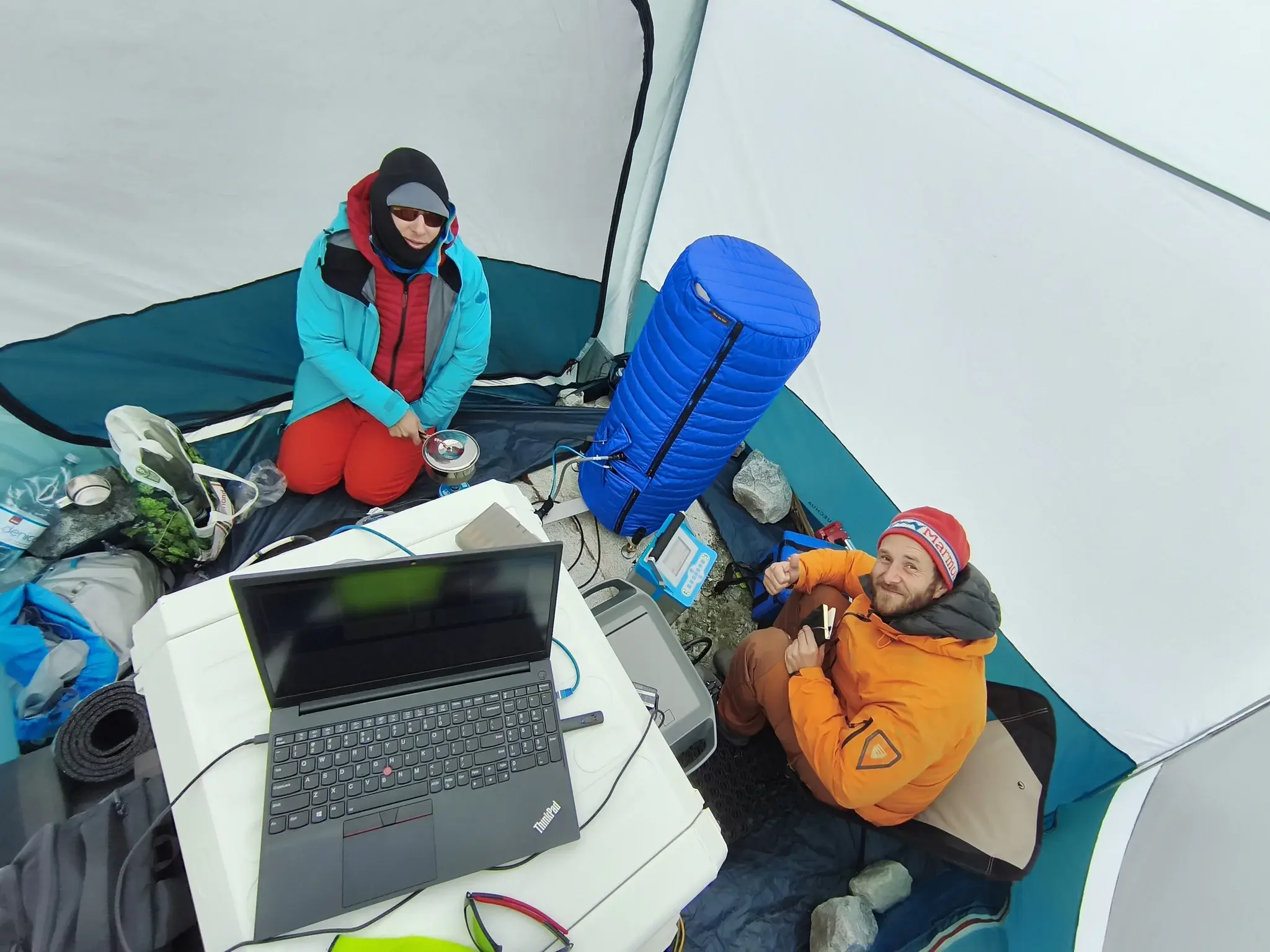
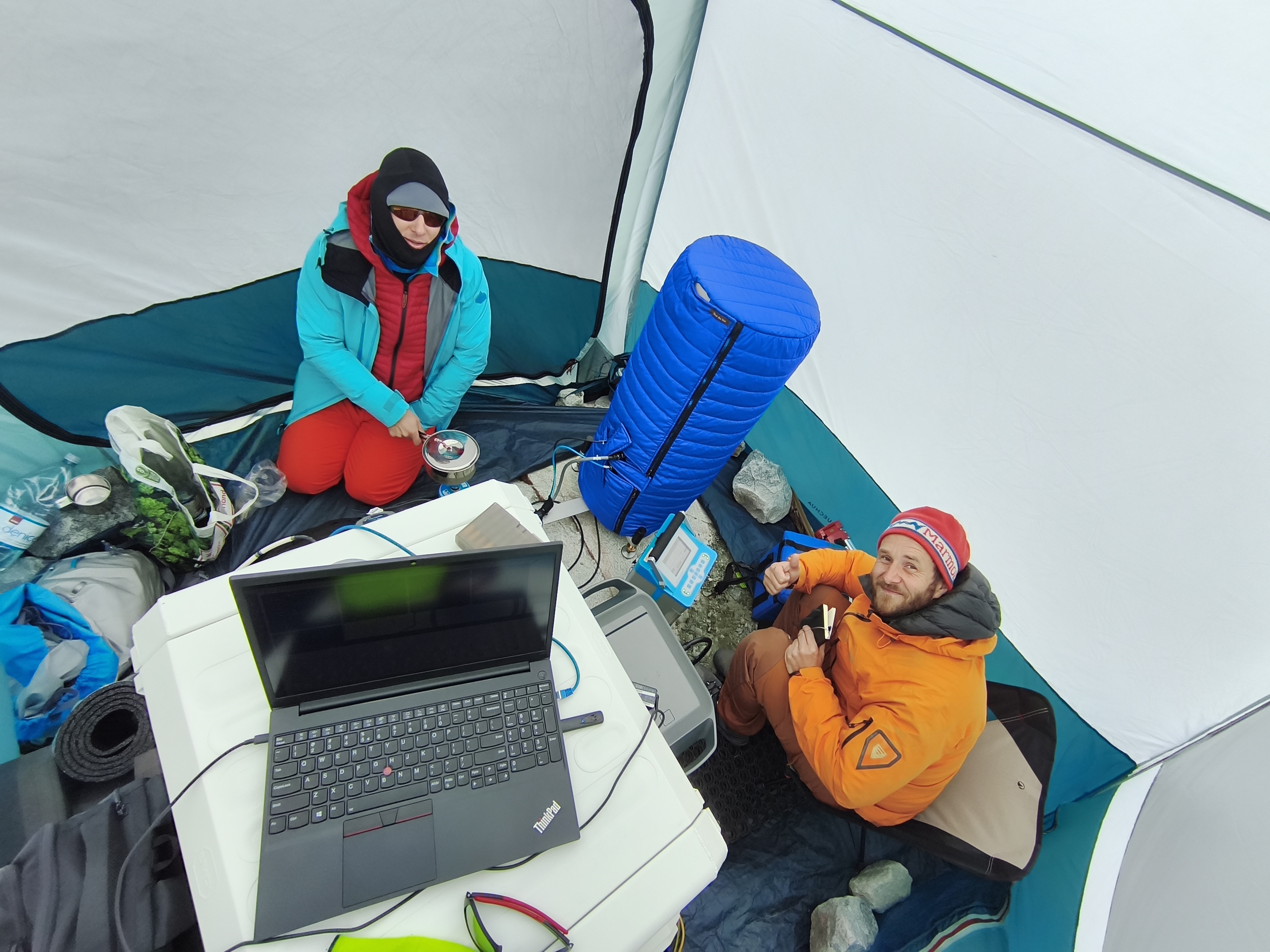
The photo captures two researchers during gravity measurements at the site. They sit inside a tent, which should provide both wind protection and thermal stability - essential requirements for maintaining measurement precision not only in the Arctic field environment. Unfortunately, it is not satisfactory. Even with the warmth from power unit that heats up the air, and people's warmth, the temperature inside the tent is only between 0-10 degrees. The cold wind outside also does not help.
At the left we see the researcher who boils a tea using camping stove to warm up the 3-people team. At the center stays AQG sensor, the core element of the whole operation. It is covered in blue down "jacket" for temperature isolation. The other researcher conducts gravity gradient measurements - normally they should be performed exactly at the measuring reference point, where the sensor unit stays. Due to lack of time, the gradient is measured next to it.
Despite hard conditions the whole operation was a great success and meaningful experience has been acquired, together with significant results.
The campaign was carried out within the project EQUIP-G (funded by the European Commission under the Horizon Europe program, grant number 101215427) and with support from the Danish Climate Data Agency, serving as a pilot study for future repeated quantum gravimetry observations in Greenland planned for 2028.
Categories
- Climate: Past, Present & Future (771)
- Cryospheric Sciences (748)
- Field (2942)
- Geodesy (56)
- People (329)
Location
- North America (793)
- Northern America (623)
- Greenland (74)
- Exact location (-49.8161 W, 69.2222 N)
Tags
- glacier (194)
- greenland (55)
- glacier front (2)
- calving (3)
- field campaign (6)
- field measurements (3)
- gravimetry (1)
- quantum (1)
- geodesy (1)
Colours
Image properties
3264 × 2448 px;
image/jpeg; 2.4 MB
Camera:
Xiaomi POCO X7 Pro
Taken on 14
August
2025
Submitted on 7 April 2026
Licence
Creative Commons Attribution 3.0 Unported (CC BY 3.0)
Credit
Adam Ciesielski (distributed via imaggeo.egu.eu)
Share
Appreciate
Report