


Soil colors written by water
by Antonio Jordán, University of Seville, Sevilla, Spain
First in English:
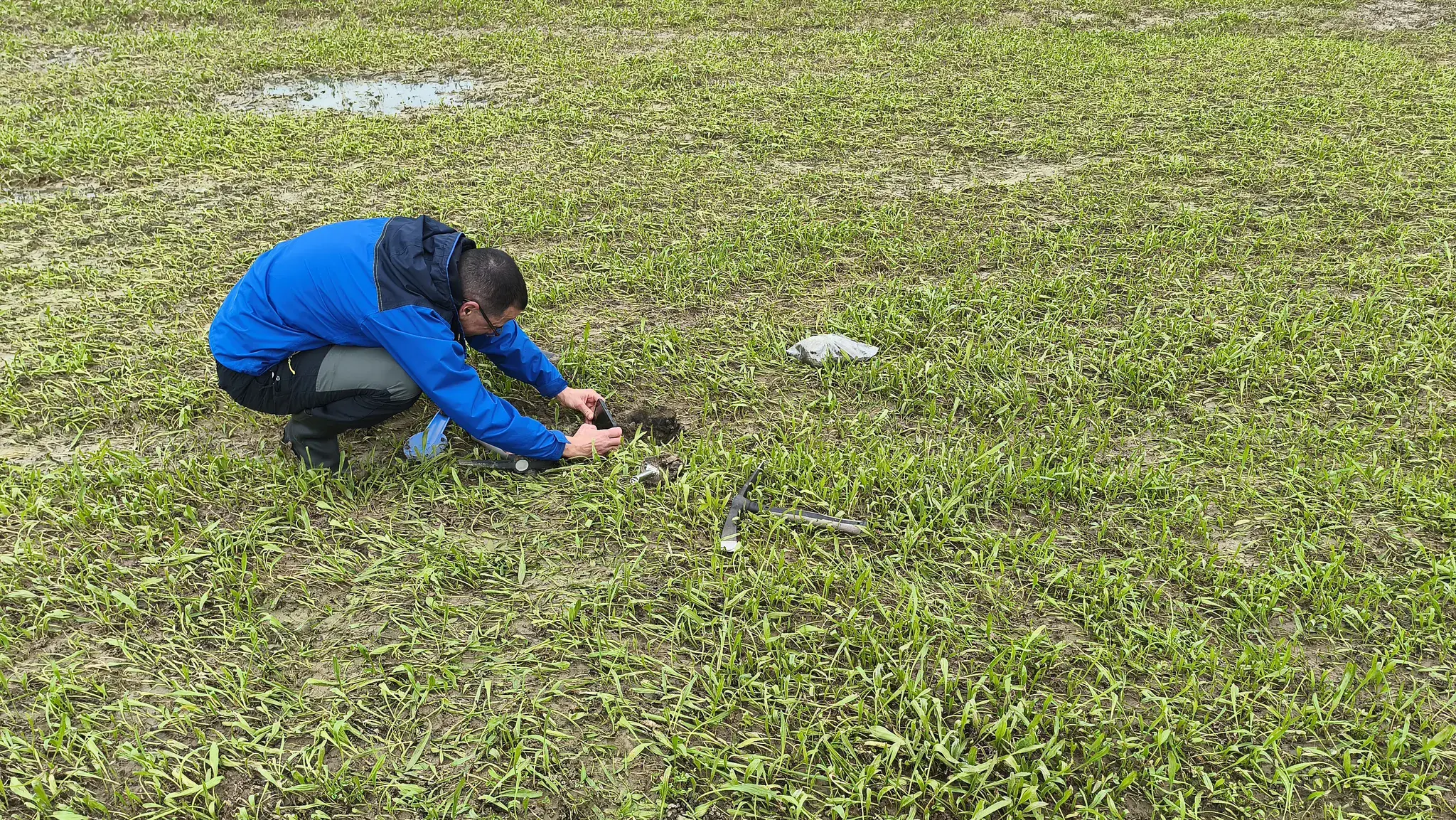
In this photograph, Gael Bárcenas-Moreno (University of Seville) is documenting redoximorphic features in a soil located on the recent terrace of the Río Guadaira (Seville, SW Spain). Kneeling on a grass-covered floodplain surface, he carefully captures the subtle color patterns exposed in a small excavation. The surrounding landscape appears flat and low-lying, typical of fluvial terraces shaped by periodic flooding and sediment deposition.
Redoximorphic features are visual indicators of alternating saturation and aeration conditions in soils. When the water table rises, oxygen becomes limited and iron (Fe³⁺) is reduced to more soluble forms (Fe²⁺). As the soil dries and oxygen re-enters, iron oxidizes again and precipitates, producing mottles, spots, and color contrasts—often in shades of gray, brown, yellow, or reddish hues. These patterns record the hydrological dynamics of the site and are key diagnostic criteria in soil classification systems such as WRB and Soil Taxonomy. In recent fluvial terraces, fluctuating groundwater levels and episodic flooding promote these redox processes, linking geomorphology, hydrology, and pedogenesis in a single soil profile.
Ahora, en español:
En esta fotografía, Gael Bárcenas-Moreno (Universidad de Sevilla) está documentando rasgos redoximórficos en un suelo situado en la terraza reciente del Río Guadaira (Sevilla, SO de España). Arrodillado sobre la superficie herbácea de la llanura de inundación, fotografía con detalle los patrones de color visibles en una pequeña excavación. El paisaje es llano y bajo, característico de terrazas fluviales formadas por inundaciones periódicas y deposición de sedimentos.
Los rasgos redoximórficos son indicadores visuales de condiciones alternantes de saturación y aireación en el suelo. Cuando el nivel freático asciende, el oxígeno se agota y el hierro (Fe³⁺) se reduce a formas más solubles (Fe²⁺). Al descender el agua y reintroducirse el oxígeno, el hierro se oxida y precipita, generando moteados y contrastes de color, frecuentemente en tonos grises, pardos, amarillentos o rojizos. Estos patrones registran la dinámica hidrológica del lugar y constituyen criterios diagnósticos fundamentales en sistemas de clasificación como la WRB o la Soil Taxonomy. En terrazas fluviales recientes, las fluctuaciones del nivel freático y las crecidas episódicas favorecen estos procesos redox, integrando geomorfología, hidrología y edafogénesis en un mismo perfil de suelo.
Categories
Location
- Europe (3936)
- Southern Europe (1713)
- Spain (841)
- Exact location (-5.9428 W, 37.3542 N)
Tags
Colours
Image properties
4080 × 2296 px;
image/jpeg; 7.7 MB
Camera:
Xiaomi Redmi Note 14 Pro 5G
Taken on 16
February
2026
Submitted on 16 February 2026
Licence
Creative Commons Attribution-ShareAlike 3.0 Unported (CC BY-SA 3.0)
Credit
Antonio Jordán (distributed via imaggeo.egu.eu)
Share
Appreciate
Report