


After the flood, the field
by Antonio Jordán, University of Seville, Sevilla, Spain
First in English:
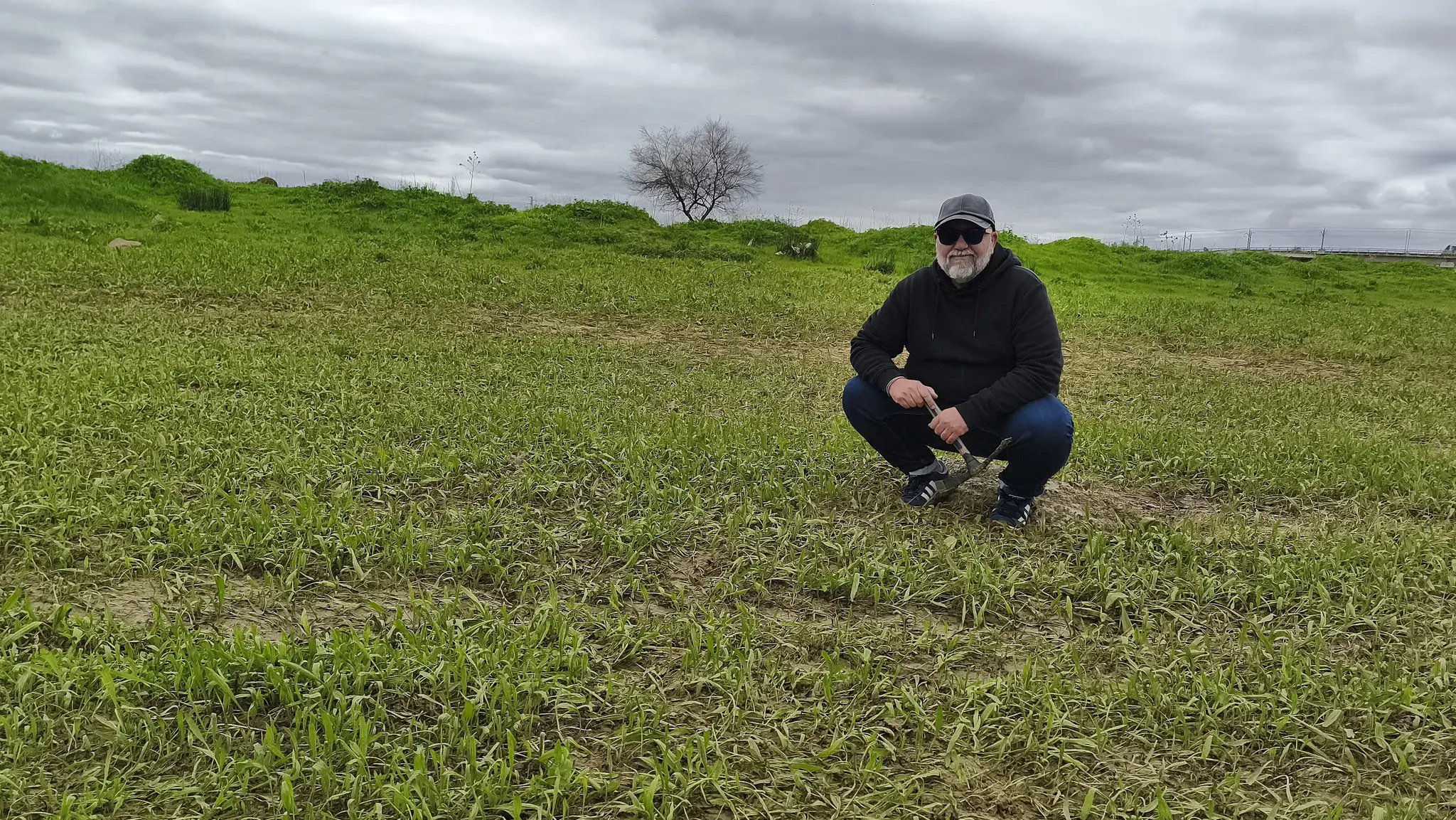
A pause for a photograph during field sampling on a low fluvial terrace associated with the channel of the Guadaira River (Seville, SW Spain). The landscape corresponds to a nearly flat to gently undulating surface that forms part of the present river terrace and is subject to periodic flooding, typically of short duration and low energy.
The vegetation cover is mainly herbaceous, dominated by annual species and grasses adapted to fluctuating soil moisture and repeated sediment inputs. The absence of well-established woody vegetation and the overall uniformity of the surface reflect an active fluvial system, where geomorphological processes still prevail over long-term landscape stabilization.
From a soil perspective, these environments give rise to young alluvial soils, classified as Fluvisols, formed through the successive deposition of river-borne sediments during flood events. These materials are arranged in weakly developed layers, often showing contrasts in texture and organic matter content depending on flow energy and proximity to the channel. The recurrence of flooding interrupts pedogenic processes, resulting in soil profiles with little horizon differentiation and a strong sedimentary imprint.
Such soils commonly exhibit high natural fertility, linked to the continuous supply of nutrients and fine particles, and a marked dynamism driven by alternating phases of saturation and drainage. Overall, low fluvial terraces represent a clear example of the balance between fluvial activity and soil formation, and they act as valuable archives of the recent hydrological and sedimentary history of the river system.
Ahora, en español:
Una pausa para la fotografía durante un muestreo de campo en una terraza fluvial baja asociada al cauce del Río Guadaira (Sevilla, SO de España). El paisaje corresponde a una superficie prácticamente plana, ligeramente ondulada, que forma parte de la terraza actual del río y que está sometida a inundaciones periódicas, aunque de corta duración y baja energía.
La cobertura vegetal es mayoritariamente herbácea, dominada por especies anuales y gramíneas adaptadas a suelos con humedad variable y a la deposición frecuente de sedimentos. La ausencia de vegetación leñosa consolidada y la homogeneidad del relieve reflejan un sistema fluvial activo, donde los procesos geomorfológicos siguen teniendo un papel dominante frente a la estabilización del paisaje.
Desde el punto de vista edáfico, estos ambientes dan lugar a suelos aluviales jóvenes, clasificados como Fluvisoles, formados por la acumulación sucesiva de materiales transportados por el río durante episodios de crecida. Los sedimentos se disponen en capas poco evolucionadas, con contrastes texturales y de contenido en materia orgánica que dependen de la energía del flujo y de la distancia al cauce. La recurrencia de las inundaciones interrumpe el desarrollo pedogenético, lo que se traduce en perfiles con escasa diferenciación de horizontes y una fuerte impronta sedimentaria.
Estos suelos suelen presentar alta fertilidad natural, asociada al aporte continuo de nutrientes y partículas finas, y una dinámica marcada por la alternancia entre fases de saturación y drenaje. En conjunto, el paisaje de terraza fluvial baja constituye un excelente ejemplo del equilibrio entre procesos fluviales y formación del suelo, y un archivo reciente de la historia hidrológica y sedimentaria del río.
Categories
Location
- Europe (3936)
- Southern Europe (1713)
- Spain (841)
- Exact location (-5.9444 W, 37.3678 N)
Tags
Colours
Image properties
4080 × 2296 px;
image/jpeg; 4.7 MB
Camera:
Xiaomi Redmi Note 14 Pro 5G
Taken on 16
February
2026
Submitted on 16 February 2026
Licence
Creative Commons Attribution-ShareAlike 3.0 Unported (CC BY-SA 3.0)
Credit
Antonio Jordán (distributed via imaggeo.egu.eu)
Share
Appreciate
Report