

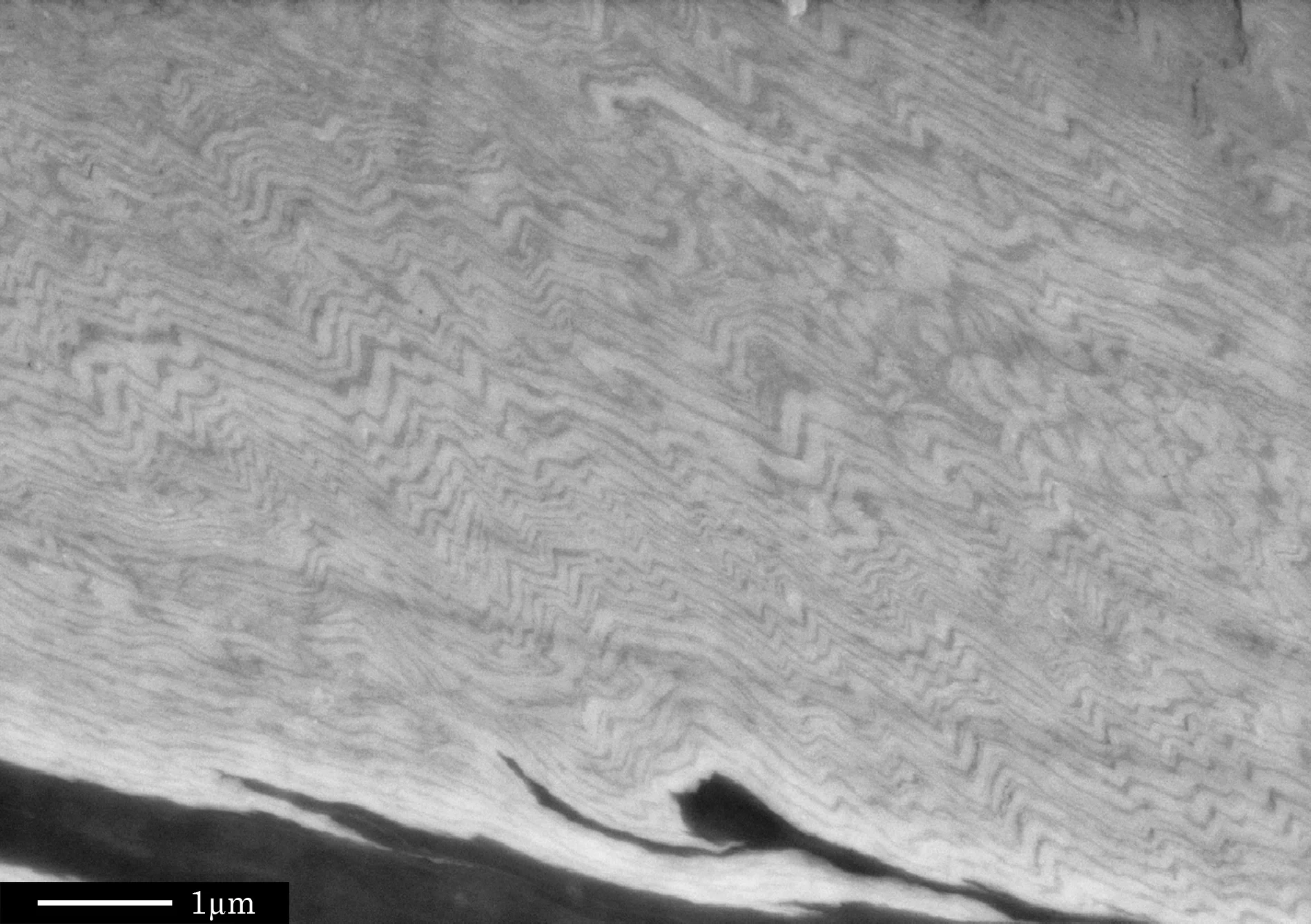
A fold belt within a grain

This is a high-magnification electron backscatter contrast image, with spectacular folds formed within a deformed pyroxene grain. The folded layers are primary exsolution lamellae of calcium rich and calcium poor pyroxene (leading to brighter and darker grey values). The anisotropy formed by these lamellae enables folding even at such a small-scale as within a single grain. This image is an astonishing example that processes, which generate geological structures operate over multiple orders of magnitude in scale.
The rock sample where this pyroxene grain was found is an experimentally deformed diabase, deformed at temperatures of 300°C and pressures of 500 MPa. The image was made at the center of microscopy (ZMB) at Basel University, with a Philips XL30 ESEM, using the BSE detector at 15 kV and an exposure time of 240 sec.
Featured on GeoLog, the official blog of the European Geosciences Union (opens in a new window)
Category
Location
Reuse
Creative Commons Attribution 3.0 Unported (CC BY 3.0) (opens in a new window)Credit: Sina Marti (distributed via imaggeo.egu.eu)











Comments
No comments yet. Be the first to share your thoughts.